Tuesday, April 24, 2012
The Historical Metallurgy Society
If you're reading this blog, you will probably be fascinated by this document from The Historical Metallurgy Society: "Metals and Metalworking, a research framework for achaeometallurgy". It's the best guide I've seen available online, bar none. You may even want to become a member.

Saturday, July 16, 2011
Help finding malachtie source in the middle east
I lifted these images of a wide Malachite vein from a youtube video. The location is somewhere (according to the video, very remote) Middle East. Anyone know if there are human-accessible veins like this anywhere in the US? I'd happily pay a mine/claim owner for permission to take a few kilos from the ground myself.


Monday, July 5, 2010
Terminology: Furnace, Forge, Kiln
Just to keep myself from going crazy with these terms, I looked them up to find out which one meant what. According to Merriam-Webster...
A furnace is the most generic term:
A furnace is the most generic term:
: an enclosed structure in which heat is produced (as for heating a house or for reducing ore)
A kiln narrows the uses to which the heat is put:
A forge narrows the thing being heated to a metal:: an oven, furnace, or heated enclosure used for processing a substance by burning, firing, or drying
: a furnace or a shop with its furnace where metal is heated and wrought
So while most of the things I discuss here could use any of these terms, I'll try to use the term furnace generally. Of course the dictionary only records the current meaning of things, so older texts may contradict.
Monday, June 28, 2010
A few more kindred spirits
Hammered Out Bits continues to provide good iron smelting data at a tremendous rate.
Lee Sauder and Skip Williams have a good page of iron smelting links at The Rockridge Bloomery. (Mel Brooks movie quotations aside)
The Early Mines Research Group has an ongoing smelting effort as well, check out the "experimental archeaology" and members-projects links.
It looks like a lot of different people are (or recently have been) interested in early metal smelting re-creation, and I would love it if whoever catches the bug next had an easier time finding resources than I did, so please: send me your references.
Lee Sauder and Skip Williams have a good page of iron smelting links at The Rockridge Bloomery. (Mel Brooks movie quotations aside)
The Early Mines Research Group has an ongoing smelting effort as well, check out the "experimental archeaology" and members-projects links.
It looks like a lot of different people are (or recently have been) interested in early metal smelting re-creation, and I would love it if whoever catches the bug next had an easier time finding resources than I did, so please: send me your references.
Sunday, June 27, 2010
Kindred Spirits
Some other folks are thinking along the same lines here, and I wanted to put up some links to their work as well.
GrendelFish aka Matthew Dockrey recorded a couple of copper smelting expirments (experiment 1 , experiment 2)
Tim Young at GeoArch has been running experiments and recording data for a succession of iron smelting efforts from 1998 through 2007.
Paul French is starting a wikipedia entry that looks very promising.
Butser Ancient Farm has their 2010 workshops posted, and Making Metals with Fergus Milton on August 14 looks pretty interesting.
See something else that needs to be on this list? Let me know!
GrendelFish aka Matthew Dockrey recorded a couple of copper smelting expirments (experiment 1 , experiment 2)
Tim Young at GeoArch has been running experiments and recording data for a succession of iron smelting efforts from 1998 through 2007.
Paul French is starting a wikipedia entry that looks very promising.
Butser Ancient Farm has their 2010 workshops posted, and Making Metals with Fergus Milton on August 14 looks pretty interesting.
See something else that needs to be on this list? Let me know!
Thursday, June 17, 2010
Think like an engineer: Cheat!
Faced with several smelting failures, I decided to apply one of the sacred tenets of practical engineering taught to me by my father: "When it won't work, cheat". I swapped out the clay forge for one made of loose-stacked firebricks, solving my spalling and insulation problems at a single blow. I was confident charcoal with forced air could get me the temperature I needed if I got a working geometry for the forge. Here's what I ended up with:
[edit post to add picture here]
Additionally a more knowledgeable copper smelter from the other side of the Atlantic Ocean, gave me some good advice about how to test for what was going wrong. (Thank you Fergus!) Armed with this information, and general his encouragement, I took another shot.
On Wednesday, 16 Jun, 2010, I completed my first copper smelt. Here's a short (and very self-important) video of the results.
I plan to do another smelt tomorrow, on a slightly larger scale, so I'll take pictures and video, and post them.
[edit post to add picture here]
Additionally a more knowledgeable copper smelter from the other side of the Atlantic Ocean, gave me some good advice about how to test for what was going wrong. (Thank you Fergus!) Armed with this information, and general his encouragement, I took another shot.
On Wednesday, 16 Jun, 2010, I completed my first copper smelt. Here's a short (and very self-important) video of the results.
I plan to do another smelt tomorrow, on a slightly larger scale, so I'll take pictures and video, and post them.
Tuesday, June 1, 2010
Stack furnace v1.0: high firing
Not to ruin the ending for you, but this is where stack furnace 1.0 started to go south. The previous day I had run two wood fires through to burnout in the forge, with no ill effects. Today I planned to do charcoal and forced air. While I had purchased bellows for this purpose, an acquaintance suggested that I just get a heat gun and some dryer duct from the hardware store, and start with that. Being short on time before my trip, I decided to go the surer route, and bought the gear.


Well, I was ready for my vacation anyway :)
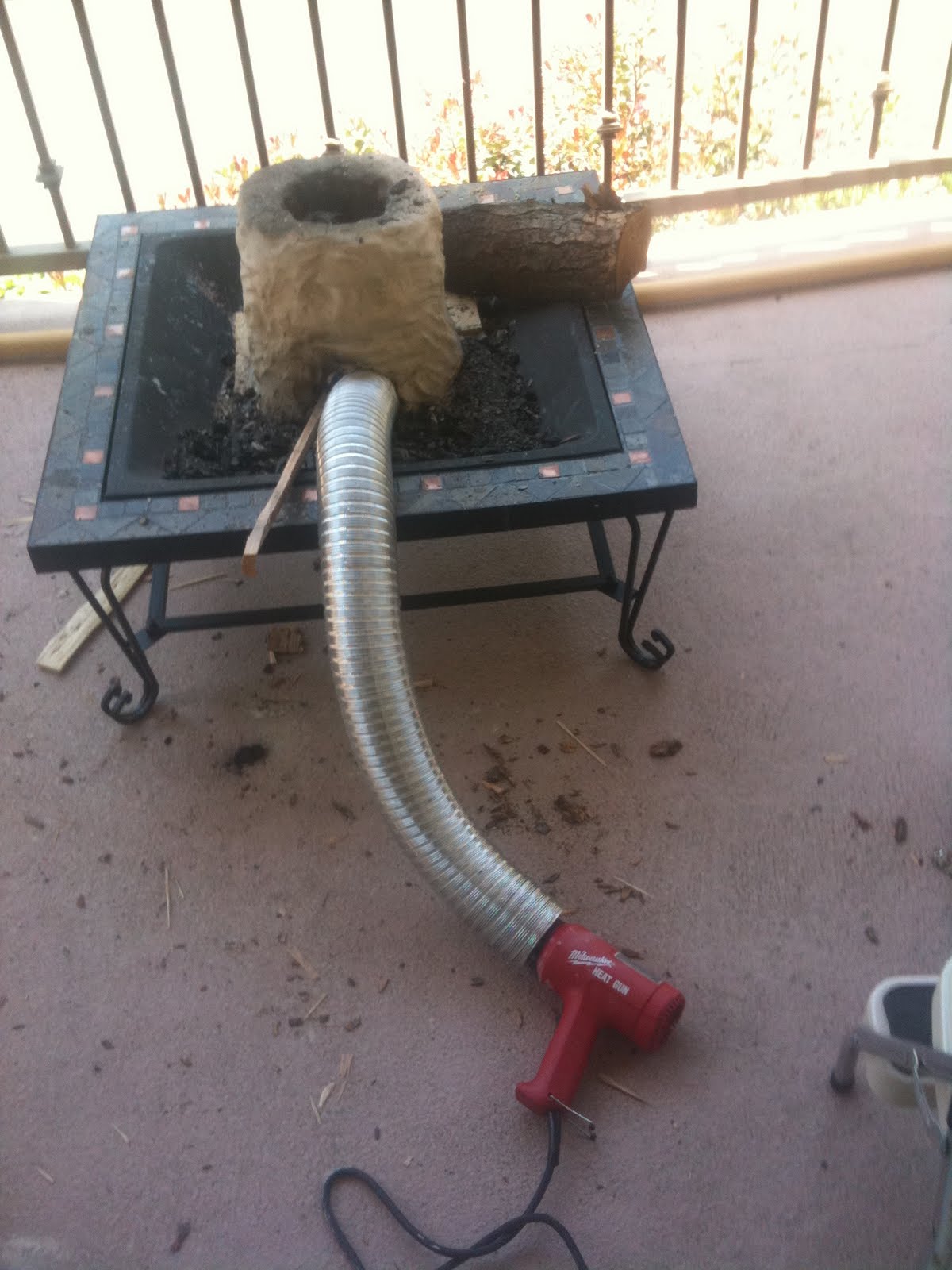

The setup turned out to be quite easy. I loaded the furnace to the brim with charcoal, lit the pile from the bottom, used a wooden wedge to keep the duct in the tuyere, and sat down to watch, periodically removing the vent to reload the charcoal.
At the beginning of the first reload, I began to hear a curious sound, a lot like popcorn popping. Those more knowledgeable readers will be wincing right now, but after checking that there were no cracks or faults developing, I assumed it was some impurity in the charcoal and blithely continued. The next odd symptom was that the ash didn't seem to be burning as completely. There was a large accumulation of unburned crap in the bottom of the forge, and it continued to grow as I fed more charcoal into it.
The third symptom was clear, however: the edges of the tuyere cracked and widened it to about 200% (and later 300%) of its original size, causing the duct to drop out. At this point, with the better view into the forge afforded by the (now quite large) tuyere, I could see that the accumulation of "ash" was actually an accumulation of spalled clay. The popping noises were caused by fire-hardened clay cracking off as less hard (and still wet) clay behind it generated steam and popped it off.
The clay body was still too wet, and I was eroding my forge from the inside out. Below are some pictures of the whole thing, the inside, and a close up of one "edge" of the tuyere
 |  |  |
Well, I was ready for my vacation anyway :)
Subscribe to:
Posts (Atom)